Cycle Planning Principles
A cycle is defined by a set of questionnaires, each of which may be used several times during the cycle. To define a cycle, you will start by selecting the questionnaires you wish to use. Remember that a questionnaire is not just a set of questions; it is also a set of options that define the submission modalities.
A cycle defines a test submission schedule, which is defined based on a pivot date, which is the starting point of the cycle, referred to as T0. For example, at T0+2 days, submit a test based on questionnaire QA.
It is also possible to define multiple deadlines for the same questionnaire, for example: every 7 days, submit a test on questionnaire QB, for a total of 8 deadlines.
Finally, you can combine these two rules to express both an initial delay relative to T0 and a periodicity, for a given number of deadlines. In English, this could be expressed as follows, for example:
Relative to T0, wait a delay of 8 days, then submit a test on questionnaire QB every 2 days, for a total of 5 deadlines.
This can be represented as follows:
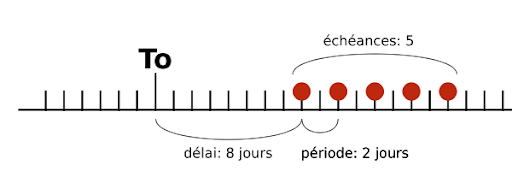
And in the Steps tab, for the selected questionnaire, you would enter delay=8, repeat=5, period=2, like this:
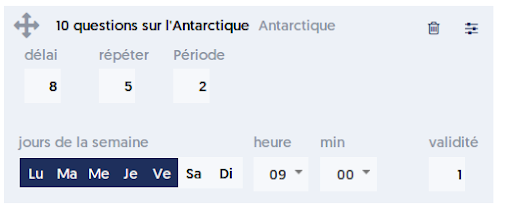
In summary:
- [5] Delay: number of days between T0 and the first test submission deadline.
- [6] Repeat: number of deadlines to schedule for this questionnaire.
- [7] Period: number of days between two deadlines.
Note that the delay parameter can be negative, which means before the pivot date T0. For example, if the pivot date is the start date of a training session, which is in 2 months, you can specify that a test should be sent one week before the training starts by entering -7 in the delay field.
There are other parameters to fine-tune the scheduling:
- [8] Days of the week: you can select the days of the week that the test can be submitted. Typically, you can select weekdays from Monday to Friday and not select the weekend. Deadlines that fall on a Saturday or Sunday will be skipped. Note that there may be fewer deadlines in total than specified in the repeat parameter.
- [9] Hour and minute of sending: this is the time at which the invitation is sent, and it is also the time at which the test can start. This is your local time; if some users are in different time zones, they will receive their invitation at a different time.
- [10] Validity: the duration, in days, during which the test can be started. Note that this is not the time available to respond, which depends on the options of the questionnaire.
If you have selected multiple different questionnaires, each has its own scheduling, and they can overlap.
It may seem irrelevant to submit the same test multiple times, but keep in mind that it could be a dynamic questionnaire, meaning that the questions asked will not be the same each time.